
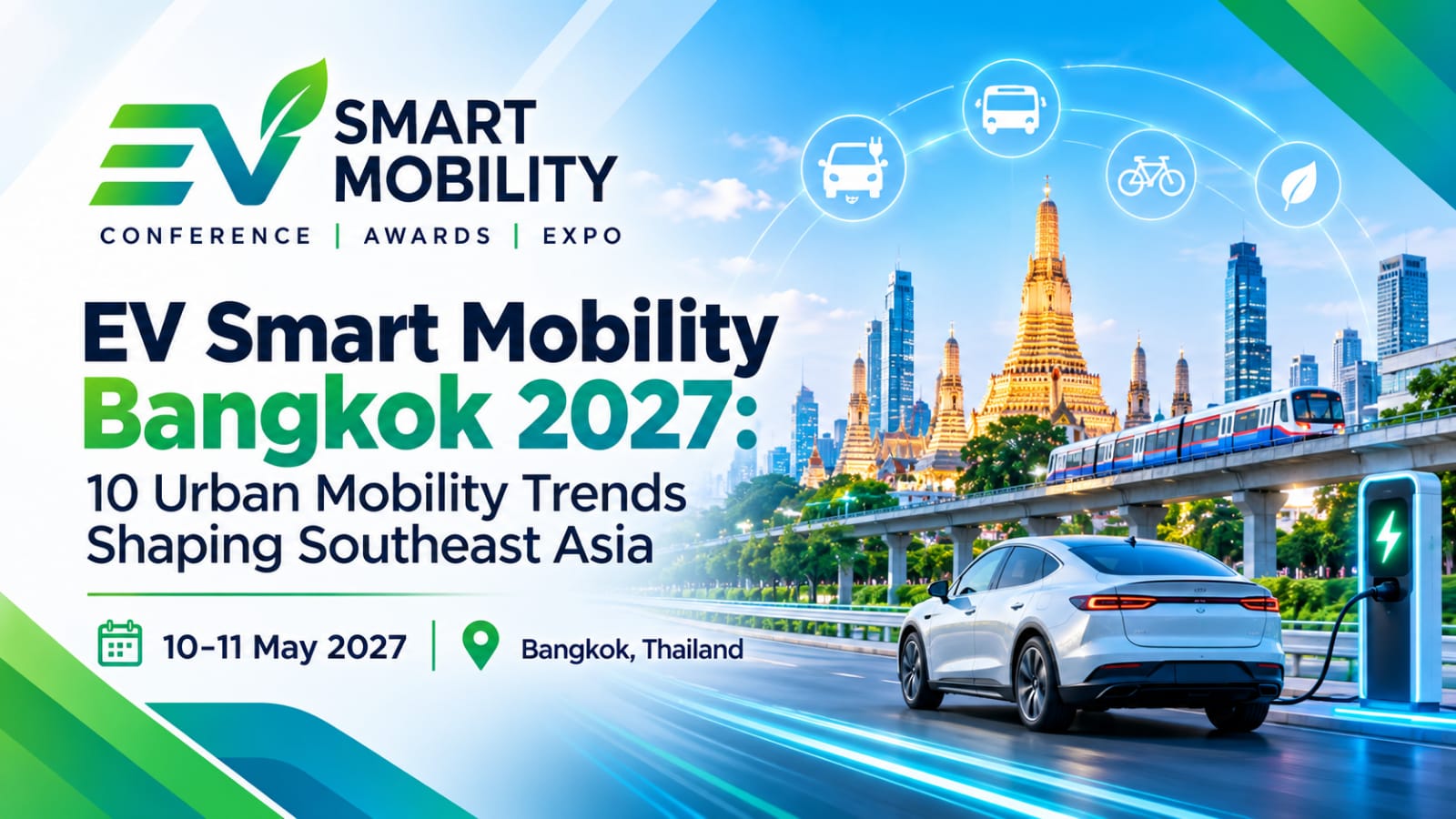
Southeast Asia’s cities are facing growing challenges from urbanization, traffic congestion, air pollution, and climate change. These pressures are encouraging governments and businesses to rethink how people and goods move. Electric vehicles, digital transport services, and intelligent infrastructure are becoming essential to the region’s mobility transition.
The Smart Mobility Conference, Awards and Expo taking place in Bangkok on 11–12 May 2027, will bring together the technologies, policies, and partnerships shaping cleaner, safer, and more connected transport across Southeast Asia.
Here are 10 urban mobility trends to watch.
Electric vehicles move towards mainstream adoption
Electric vehicles are becoming an increasingly important part of Southeast Asia’s transport transition. Thailand, in particular, is building policies and investment frameworks to support low-carbon mobility through its 2025–2035 e-mobility agenda.
Beyond passenger cars, electric two-wheelers, three-wheelers, buses, and commercial fleets will play an important role in meeting the needs of densely populated cities.
Charging infrastructure becomes essential
Expanding EV adoption requires reliable and accessible charging networks. Thailand’s charging infrastructure has grown rapidly, with more than 11,000 public charging ports reported by late 2024.
Future development will focus on fast-charging corridors, workplace and destination charging, smart grid management, and interoperable payment systems. These improvements will make EV ownership and fleet operations more practical.
Public transport goes electric
Electric buses, e-tuk-tuks, and electric ferries offer opportunities to reduce transport emissions and improve urban air quality. Thailand is already supporting electric public transport through financing initiatives and pilot projects.
Expanding these services could help cities reduce dependence on conventional fuels while improving the daily commuting experience.
Mobility-as-a-Service connects the journey
Mobility-as-a-Service (MaaS) brings different transport options, including buses, trains, ride-hailing, and bike-sharing, into a connected digital platform.
In Southeast Asia, better integration could make public transport more convenient through real-time information, simplified payments, and improved first- and last-mile connections.
Data supports smarter urban transport
Data from vehicles, roads, sensors, and public transport systems can help cities manage congestion, optimize routes, and improve road safety.
However, successful implementation will require clear policies covering data sharing, privacy, cybersecurity, and responsible use.
AI improves transport efficiency and safety
Artificial intelligence is creating new opportunities for urban mobility. Applications include traffic prediction, adaptive traffic signals, incident detection, fleet optimization, and predictive vehicle maintenance.
For Southeast Asian cities, these technologies could address practical challenges such as congested roads, unreliable transport schedules, and inefficient delivery routes.
Connected and autonomous mobility advances
Although fully autonomous vehicles still face technical and regulatory challenges, connected mobility is progressing. Vehicle-to-infrastructure communication, advanced driver-assistance systems, and fleet monitoring can improve transport safety and efficiency.
Thailand is also advancing connected and autonomous mobility through research and real-world testing of advanced vehicle technologies. Thailand's first Level 4 autonomous vehicle testing highlights the country's progress in this area.
Initial applications are likely to focus on controlled environments such as airports, ports, industrial facilities, and selected pilot zones.
Micromobility strengthens last-mile connections
Electric scooters, e-bikes, e-mopeds, and shared electric three-wheelers can make short-distance travel more convenient and connect commuters to public transport.
The next stage of development will depend on safer cycling infrastructure, designated parking, speed management, and better integration with transit stations.
Green finance supports the mobility transition
The shift towards electric transport requires investment in vehicles, batteries, charging stations, grid upgrades, and digital infrastructure. Thailand’s e-mobility transition agenda highlights the importance of investment and private-sector participation. Green bonds, blended finance, fleet leasing, and public-private partnerships can help fund these projects.
Regional collaboration shapes the future
Southeast Asia’s mobility transition will require cooperation between governments, businesses, and technology providers. Shared standards for charging, vehicle safety, data exchange, and battery recycling will help strengthen the regional ecosystem.
Bangkok is an important location for these discussions, bringing together stakeholders working across EVs, batteries, charging infrastructure, connected vehicles, AI, and intelligent transportation systems.
The Smart Mobility Conference, Awards and Expo will provide a platform for policymakers, manufacturers, technology providers, investors, fleet operators, and urban planners to explore the next phase of sustainable mobility.
Register now: https://evsmartmobilityconference.com